Lyme Disease Rash: The Bullseye You Shouldn’t Ignore
A red patch that keeps growing over days at the site of a tick bite — sometimes clearing in the centre into a bullseye ring — is called erythema migrans, and it’s the hallmark of early Lyme disease. Here’s the crucial part: this rash is the diagnosis. No blood test is needed, and prompt antibiotics stop Lyme before it can reach joints, nerves or the heart. A registered Irish doctor can assess the rash by photo and video today for €34.99.
Book a Lyme rash consultation — pick a time below
The consultation is preselected. Choose a slot, add your details, and a registered Irish doctor will call you.
Employer sick notes issued for up to 7 days. No physical examination or wet signature required. Appointments typically within 30 minutes. At busy times, your doctor may call up to 20 minutes after your booked time.
Your consultation will be with one of our IMC-registered doctors
📱 In the DoxOnCall app this consultation is €34.99€27.99 — code DOXAPP20 on your first app booking. Get the free app ›
📞 The doctor calls you — no waiting room
✅ IMC-registered Irish doctors
🕑 All times are Irish time
Pick a date to see available times
Your Details
All fields marked * are required
You're booking
Your information is encrypted and protected under GDPR
Secure payment next — you won't be charged until you confirm. Having trouble making payment or securing your slot? 💬 WhatsApp our support team
Booking for yourself? You've given the patient your own name and date of birth.You've given the patient your own name, with no date of birth for them.
Review & Pay
Confirm your booking details below
One certificate per consultation
A sick note and a fit-to-work certificate certify opposite things — that you are unfit for work, and that you are fit to return. Each needs its own clinical assessment, so they cannot both be issued from the same consultation. If you need both, please book two separate appointments. Booking this consultation intending to obtain both does not entitle you to a refund.
Appears 3 days to 3 months after a tick bite (most often 1–4 weeks) — anywhere ticks reach: legs, groin, waistband, armpits, hairline in children.
Expands steadily to 5 cm or more — often much larger; may form the classic ring or stay a solid patch.
Usually not very itchy or painful — which is why it gets ignored.
May come with flu-like symptoms: tiredness, headache, muscle and joint aches, mild fever.
Ticks are common in Irish woodland, heath and long grass — Wicklow, Kerry, Galway, Donegal and rural walking country generally.
Not every bite reaction is Lyme: a small red bump within hours of a bite that fades in a day or two is a normal reaction. It’s the expanding rash over days that matters.
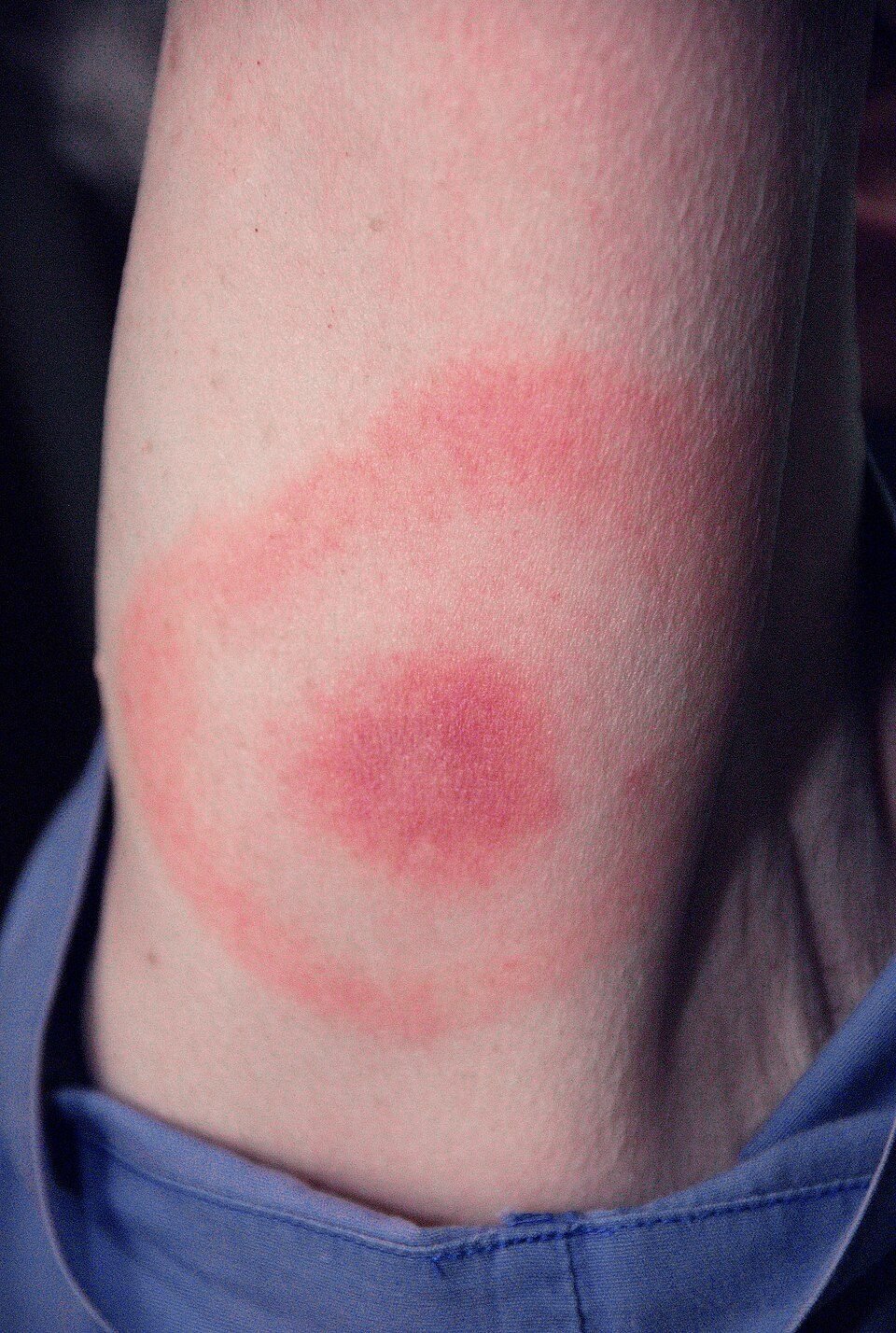
The classic bullseye — a slowly expanding ring around the bite site. If yours looks like this, note the date of the tick bite before you book. Photo: James Gathany, CDC Public Health Image Library — public domain.
Treatment
Antibiotics on sight of the rash — typically doxycycline for 21 days (alternatives exist for children and in pregnancy). Starting promptly is what prevents later complications.
No test needed for the rash stage — blood tests are often still negative early on and shouldn’t delay treatment when erythema migrans is present.
Photograph the rash with something for scale (a coin) and mark its edge with a pen — growth between photos is diagnostic gold for the doctor.
Get urgent medical care — beyond an online consultation — for facial droop or weakness, severe headache with a stiff neck, shooting nerve pains or numbness, palpitations, fainting or chest pain, or a painful swollen joint after possible tick exposure. These suggest Lyme has spread and needs in-person assessment and sometimes hospital treatment.
Found a tick still attached? Remove it promptly with fine-tipped tweezers or a tick tool: grip at skin level, pull straight up without twisting or squeezing the body, then clean the site. Note the date, and watch the area for a growing rash over the following weeks. Most tick bites do NOT transmit Lyme — quick removal cuts the risk further.
How the online consultation works
Book a time above — same-day appointments are usually available, seven days a week.
Show the rash by video and photos — with the story of where and when you were bitten.
Get treated — where the rash fits erythema migrans, antibiotics are prescribed electronically to your pharmacy the same day, with clear follow-up and red-flag guidance.
Frequently asked questions
How do I tell a Lyme rash from a normal bite reaction?
Timing and growth. A normal bite reaction appears within hours and fades within days, staying small. Erythema migrans appears days to weeks later and keeps expanding past 5 cm — with or without a bullseye centre.
Do I need a blood test for Lyme disease?
Not when the classic expanding rash is present — tests are frequently negative in the first weeks and treatment shouldn’t wait for them. Testing has a role in later or unclear presentations.
I never saw a tick — could it still be Lyme?
Yes. Nymph ticks are poppy-seed small and most people with Lyme never noticed the bite. The rash pattern and outdoor exposure are what count.
What happens if a Lyme rash isn’t treated?
The rash fades by itself — but the infection can later involve joints (swollen knees), nerves (facial droop, nerve pain) or the heart. Early antibiotics prevent almost all of this, which is why treating the rash promptly matters.
Should I take antibiotics after every tick bite, just in case?
Routine preventive antibiotics aren’t recommended in Ireland — most bites don’t transmit Lyme. Remove the tick properly, note the date, and seek review if a spreading rash or symptoms appear.
Can children be treated the same way?
Yes — childhood Lyme rash is treated promptly too, with antibiotic choice adjusted for age. Photos plus a video consultation work well; the doctor will say if an in-person check is needed.
This page is general health information, not a diagnosis. A registered Irish doctor will assess your individual situation during your consultation. In an emergency call 999 or 112.
Aoife isn't a doctor. For emergencies call 999 or 112.
WhatsApp us
🍪
We value your privacy
We use cookies to improve your experience on our site. Essential cookies are required for core functionality. Analytics and marketing cookies help us understand how you use our site and measure ad performance. You can choose which cookies to allow. Learn more
Strictly NecessaryRequired for the website to function. Cannot be disabled.
AnalyticsGoogle Analytics — helps us understand how visitors use the site.
One use per patient, on a booking made in the app. iPhone and Android. Not redeemable on the website.
We use cookies. DoxOnCall uses essential cookies to make the booking flow work, plus analytics and advertising-measurement cookies that help us see which ads bring patients so we can keep booking costs low. You can opt out anytime. See our privacy policy for detail.
Essential cookies
Required for the site, booking, and login to work. Cannot be disabled.
Analytics cookies
Anonymised usage analytics (Google Analytics 4) so we can see which pages help patients most. We do not sell or share this data.
Advertising-measurement cookies
Let us measure which online ads (e.g. Google Ads) lead to bookings, so we can keep our prices and booking costs low. No third-party ads are shown to you on this site.