Eczema Flare-Ups: Calming the Itch & Breaking the Cycle
Red, dry, cracked skin that itches until you scratch it raw — an eczema flare can wreck sleep, work and patience. Flares respond well to the right-strength steroid cream used properly, and infected eczema needs more than moisturiser. A registered Irish doctor can assess your skin by video for €34.99, prescribe what the flare actually needs, and set up a routine that keeps skin calm afterwards.
Book an eczema consultation — pick a time below
The consultation is preselected. Choose a slot, add your details, and a registered Irish doctor will call you.
Employer sick notes issued for up to 7 days. No physical examination or wet signature required. Appointments typically within 30 minutes. At busy times, your doctor may call up to 20 minutes after your booked time.
Your consultation will be with one of our IMC-registered doctors
📱 In the DoxOnCall app this consultation is €34.99€27.99 — code DOXAPP20 on your first app booking. Get the free app ›
📞 The doctor calls you — no waiting room
✅ IMC-registered Irish doctors
🕑 All times are Irish time
Pick a date to see available times
Your Details
All fields marked * are required
You're booking
Your information is encrypted and protected under GDPR
Secure payment next — you won't be charged until you confirm. Having trouble making payment or securing your slot? 💬 WhatsApp our support team
Booking for yourself? You've given the patient your own name and date of birth.You've given the patient your own name, with no date of birth for them.
Review & Pay
Confirm your booking details below
One certificate per consultation
A sick note and a fit-to-work certificate certify opposite things — that you are unfit for work, and that you are fit to return. Each needs its own clinical assessment, so they cannot both be issued from the same consultation. If you need both, please book two separate appointments. Booking this consultation intending to obtain both does not entitle you to a refund.
Patches of red, rough, intensely itchy skin — classically elbow creases, behind the knees, hands, face and neck.
Scratching thickens the skin and drives the itch–scratch cycle that keeps a flare alive.
Infected eczema looks different: weeping, golden crusting, rapidly spreading redness, warmth or pus spots — it needs treatment for the infection, not just steroids.
Same-day medical care needed: clusters of small, painful, punched-out blisters or ulcers spreading quickly across eczema — especially with fever or feeling unwell — can be eczema herpeticum, a herpes-virus infection of eczema that is sight- and health-threatening. This is urgent: contact a doctor immediately or attend an Emergency Department, particularly in children.
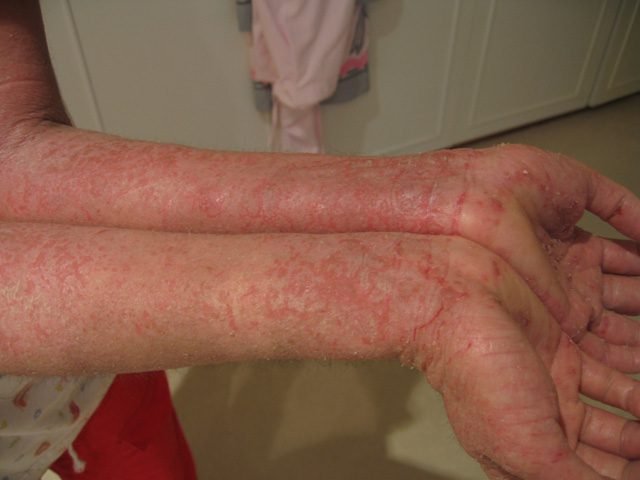
A flare in full swing: red, dry, angry skin. Emollients plus a proper steroid course calm this down. Photo via Wikimedia Commons — public domain.
Treating the flare properly
The two-part approach
Steroid cream or ointment at the right strength — strong enough to switch the flare off, used once or twice daily until the skin is fully smooth (typically 1–2 weeks), then stepped down. Under-treating with a too-mild cream “forever” is the most common mistake in eczema care.
Emollients, generously and always — moisturise several times a day, every day, flare or no flare, and swap soap for an emollient wash. This is what prevents the next flare.
What a doctor can add
Prescription-strength steroid creams matched to the body site (mild for the face, stronger for hands and body).
Antibiotics — oral or topical — when the eczema is infected.
Steroid-sparing creams (calcineurin inhibitors) for delicate areas that flare repeatedly.
Antihistamines to break the night-time scratch cycle; wet wraps advice for children.
Trigger review — soaps, fragrances, wool, heat, stress, house-dust mite — plus referral if eczema stays severe despite good treatment.
Steroid-cream fear is common — and usually misplaced. Used correctly (right strength, right site, until clear, then stopped or stepped down), steroid creams are safe and are exactly how flares are meant to be treated. Problems come from the two extremes: months of unsupervised daily use, or so little that the flare never settles. The doctor will give you a clear, written plan.
How the online consultation works
Book a time above — same-day appointments are usually available, seven days a week.
Show the affected skin by video — good-light photos of each area help.
Get your plan — the right-strength treatment prescribed to your pharmacy, infection covered if present, and a maintenance routine to keep skin clear.
Frequently asked questions
How do I know if my eczema is infected?
Weeping fluid, golden or honey-coloured crusts, spreading hot redness, pus spots, or a flare that suddenly worsens despite treatment all point to infection — it usually needs antibiotic treatment alongside the flare care.
Are steroid creams safe?
Yes, used properly: the right strength for the body site, once or twice daily until the skin is fully clear, then stepped down. Skin thinning comes from months of inappropriate continuous use — not from treating flares correctly.
How often should I moisturise?
At least twice a day — ideally three or four times, and always after washing — using a generous amount of a fragrance-free emollient. Continue every day even when the skin looks clear; that’s what prevents flares.
Why does my eczema keep coming back?
Usually a mix of under-treated flares, stopping emollients once skin looks fine, and ongoing triggers (soaps, fragranced products, heat, stress, dust mite). A proper routine — and sometimes a twice-weekly preventative cream on trouble spots — breaks the cycle.
Can an online doctor really assess eczema?
Yes — eczema is largely a visual and history-based diagnosis. Video plus close-up photos lets a registered Irish doctor grade the flare, spot infection, and prescribe appropriately; anything that genuinely needs in-person review will be told to you straight.
Is eczema contagious?
No. Eczema itself cannot be passed on — though infected eczema can shed bacteria, and eczema herpeticum involves a transmissible virus, which is one more reason infected-looking eczema should be reviewed promptly.
This page is general health information, not a diagnosis. A registered Irish doctor will assess your individual situation during your consultation. In an emergency call 999 or 112.
Aoife isn't a doctor. For emergencies call 999 or 112.
WhatsApp us
🍪
We value your privacy
We use cookies to improve your experience on our site. Essential cookies are required for core functionality. Analytics and marketing cookies help us understand how you use our site and measure ad performance. You can choose which cookies to allow. Learn more
Strictly NecessaryRequired for the website to function. Cannot be disabled.
AnalyticsGoogle Analytics — helps us understand how visitors use the site.
One use per patient, on a booking made in the app. iPhone and Android. Not redeemable on the website.
We use cookies. DoxOnCall uses essential cookies to make the booking flow work, plus analytics and advertising-measurement cookies that help us see which ads bring patients so we can keep booking costs low. You can opt out anytime. See our privacy policy for detail.
Essential cookies
Required for the site, booking, and login to work. Cannot be disabled.
Analytics cookies
Anonymised usage analytics (Google Analytics 4) so we can see which pages help patients most. We do not sell or share this data.
Advertising-measurement cookies
Let us measure which online ads (e.g. Google Ads) lead to bookings, so we can keep our prices and booking costs low. No third-party ads are shown to you on this site.