Whiteheads, blackheads, angry red spots or deep painful bumps — acne is the most common skin condition there is, and also one of the most treatable. The catch: pharmacy products alone often are not enough, and waiting “to grow out of it” risks scars that outlast the spots. A registered Irish doctor can review your skin by video for €34.99 and prescribe evidence-based treatment matched to your acne type.
Book an acne consultation — pick a time below
The consultation is preselected. Choose a slot, add your details, and a registered Irish doctor will call you.
Employer sick notes issued for up to 7 days. No physical examination or wet signature required. Appointments typically within 30 minutes. At busy times, your doctor may call up to 20 minutes after your booked time.
Your consultation will be with one of our IMC-registered doctors
📱 In the DoxOnCall app this consultation is €34.99€27.99 — code DOXAPP20 on your first app booking. Get the free app ›
📞 The doctor calls you — no waiting room
✅ IMC-registered Irish doctors
🕑 All times are Irish time
Pick a date to see available times
Your Details
All fields marked * are required
You're booking
Your information is encrypted and protected under GDPR
Secure payment next — you won't be charged until you confirm. Having trouble making payment or securing your slot? 💬 WhatsApp our support team
Booking for yourself? You've given the patient your own name and date of birth.You've given the patient your own name, with no date of birth for them.
Review & Pay
Confirm your booking details below
One certificate per consultation
A sick note and a fit-to-work certificate certify opposite things — that you are unfit for work, and that you are fit to return. Each needs its own clinical assessment, so they cannot both be issued from the same consultation. If you need both, please book two separate appointments. Booking this consultation intending to obtain both does not entitle you to a refund.
Whiteheads and blackheads (comedones) — blocked pores, the starting point of most acne.
Inflammatory spots — red papules and pus-filled pustules.
Nodules and cysts — deep, painful lumps that heal slowly and scar most readily.
Adult and hormonal acne — often along the jawline and chin, flaring before periods.
The right treatment depends on the type and severity — which is exactly what the doctor assesses on video and from photos.
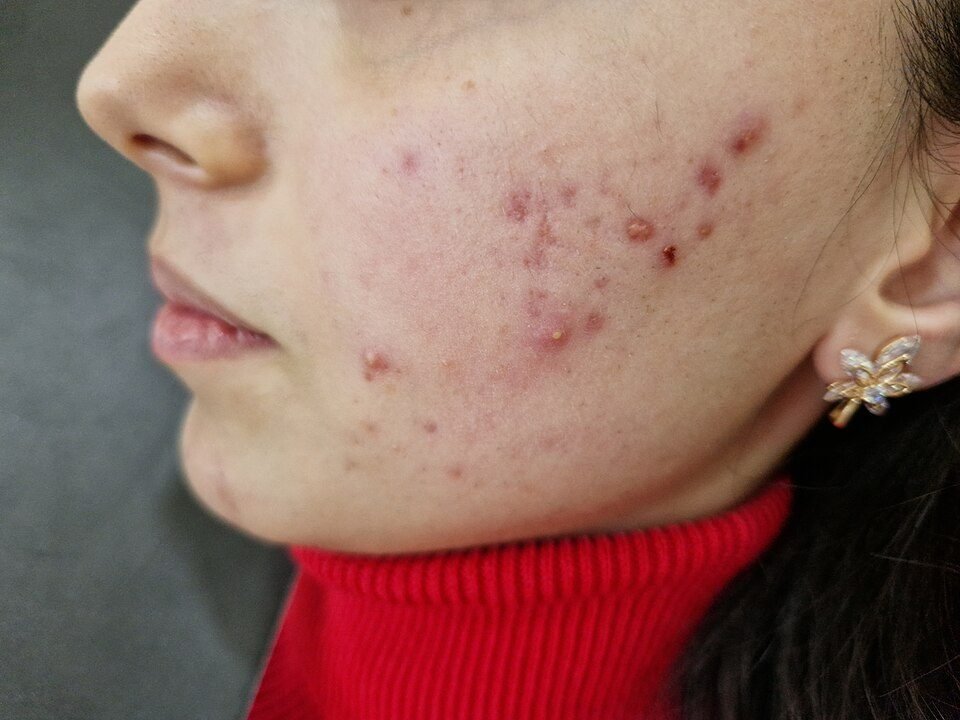
Papules, pustules and deeper bumps on the cheek — the inflammatory acne that prescription treatment shifts. Photo: Sedef94, Wikimedia Commons, CC BY-SA 4.0.
Treatments that are proven to work
First steps
Benzoyl peroxide wash or gel — kills the acne bacteria; available from pharmacies.
Adapalene (a retinoid) — unblocks pores and prevents new comedones; the cornerstone for whiteheads and blackheads.
Gentle, non-comedogenic skincare — harsh scrubbing makes acne worse, not better.
Azelaic acid — good for sensitive skin and post-spot marks.
Oral antibiotics (e.g. lymecycline) for moderate inflammatory acne — always combined with a topical and time-limited.
Hormonal treatment — certain combined contraceptive pills genuinely help many women with jawline/hormonal acne.
Deep, scarring or cystic acne? Don’t wait it out. Severe nodulocystic acne deserves early, aggressive treatment and sometimes referral for isotretinoin (Roaccutane) — a specialist-supervised medicine. The sooner treatment starts, the less scarring you carry forward. Book promptly rather than cycling through more pharmacy products.
See a doctor urgently if acne suddenly becomes severe with fever, joint pains and ulcerating spots (a rare form called acne fulminans), or if a facial spot becomes rapidly hot, swollen and spreading — that’s a skin infection, not a pimple.
What to expect from treatment
Most treatments need 6–8 weeks of consistent use before you judge them — acne improves in months, not days.
Mild dryness or irritation early on is common and usually settles; the doctor will show you how to build up gradually.
Dark marks left after spots fade with time and are helped by azelaic acid and daily SPF.
A follow-up review keeps treatment on track and steps it up if progress stalls.
How the online consultation works
Book a time above — same-day and evening slots are usually available.
Show your skin by video — close-up photos in good light help the doctor grade the acne accurately.
Get your plan — a stepwise treatment matched to your skin, prescriptions sent electronically to your pharmacy, and a clear review point.
Frequently asked questions
How long until acne treatment works?
Give any regimen 6–8 weeks of consistent use before judging it. Spots often look unchanged for the first few weeks — stopping early is the single most common reason treatment “fails”.
Can an online doctor prescribe acne medication?
Yes — topical retinoids, combination gels, azelaic acid, oral antibiotics and suitable hormonal options can all be prescribed where appropriate, with the prescription sent electronically to your pharmacy. Isotretinoin (Roaccutane) requires specialist supervision — if you need it, the doctor can refer you.
Does diet cause acne?
Chocolate and chips are not the villains they were painted as. Evidence weakly links high-glycaemic diets and some dairy (especially skimmed milk) with acne in some people, but treatment works regardless of diet.
Should I squeeze whiteheads?
No — squeezing pushes inflammation deeper, spreads bacteria and is the fastest route to marks and scars. Treatment that unblocks pores (like adapalene) removes the temptation.
Why is my acne worse before my period?
Hormonal fluctuations increase oil production in the days before a period, typically flaring the jawline and chin. If this is your pattern, mention it — hormonal treatment options work particularly well for it.
Will acne leave scars?
Deep or squeezed spots can. The best scar prevention is early effective treatment — and daily sunscreen, which stops the red and brown marks from darkening while they fade.
This page is general health information, not a diagnosis. A registered Irish doctor will assess your individual situation during your consultation. In an emergency call 999 or 112.
Aoife isn't a doctor. For emergencies call 999 or 112.
WhatsApp us
🍪
We value your privacy
We use cookies to improve your experience on our site. Essential cookies are required for core functionality. Analytics and marketing cookies help us understand how you use our site and measure ad performance. You can choose which cookies to allow. Learn more
Strictly NecessaryRequired for the website to function. Cannot be disabled.
AnalyticsGoogle Analytics — helps us understand how visitors use the site.
One use per patient, on a booking made in the app. iPhone and Android. Not redeemable on the website.
We use cookies. DoxOnCall uses essential cookies to make the booking flow work, plus analytics and advertising-measurement cookies that help us see which ads bring patients so we can keep booking costs low. You can opt out anytime. See our privacy policy for detail.
Essential cookies
Required for the site, booking, and login to work. Cannot be disabled.
Analytics cookies
Anonymised usage analytics (Google Analytics 4) so we can see which pages help patients most. We do not sell or share this data.
Advertising-measurement cookies
Let us measure which online ads (e.g. Google Ads) lead to bookings, so we can keep our prices and booking costs low. No third-party ads are shown to you on this site.