
Scabies Treatment Not Working? Here’s Why – and How to Get Rid of It for Good
Scabies is a common, uncomfortable, and a very treatable condition. However, when symptoms don’t improve—or come back after treatment—it can be incredibly frustrating.
In most cases, treatment failure does not mean the medicine didn’t work. It usually happens because scabies mites are re-introduced or treatment steps weren’t fully followed, as instructed by your doctor.
Our guide explains:
Why scabies treatment sometimes usually fails
What does term “resistant scabies” really means
How to correctly and effectively treat scabies at home
How to protect yourself and your close contacts
Our goal is to help you clear your scabies completely and permanently.
What Is Scabies?
Scabies is a skin condition caused by a tiny mites (Sarcoptes scabiei). These mites burrow into the skin, causing:
Intense itching, which is often worse at night
Rash, bumps, or burrow-like lines are common
Commonly affected areas include finger web spaces, wrists, fingers, elbows, waist, genitals, and buttocks
Scabies spreads through prolonged skin-to-skin contact, not poor hygiene.
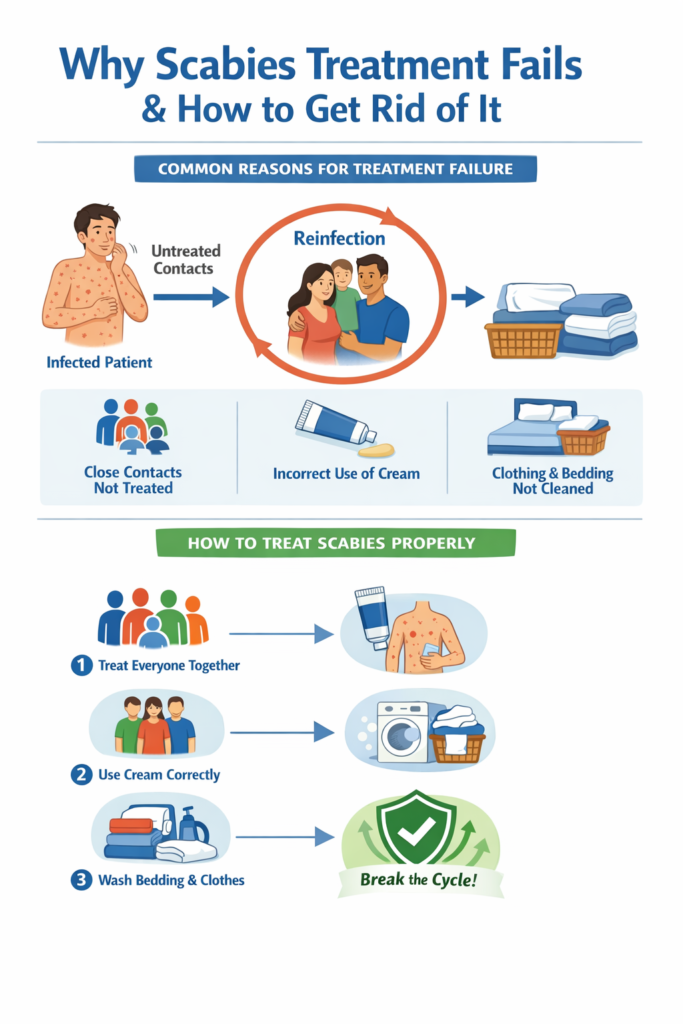
Why Scabies Treatment Often Fails?
1. Close Contacts Didn’t Receive Treatment
This is the most common reason scabies treatment fails. All close contacts must be treated at the same time, even if they have no symptoms.
Close contacts includes:
Sexual partners
People living in the same household
Anyone with regular close physical contact
If one person is not treated, scabies can easily spread back again.
2. Incorrect Use of Topical Treatment
The first choice treatment in Ireland is permethrin 5% cream (Lyclear®). Some patients may need a second application one week later to complete the treatment.
If permethrin is not suitable or available, your doctor may prescribe malathion lotion (Derbac M®).
Oral Option (for Difficult Cases)
Oral ivermectin may be considered for treatment-resistant scabies.
Permethrin 5% and Malathion work well only when used correctly. Many treatment failures are due to the incorrect application.
Common mistakes include:
Using too little cream
Washing it off too early
Missing parts of the body
Areas that are often missed include:
Between fingers and toes
Under fingernails
Genitals and buttocks
Soles of the feet
Permethrin must usually be left on the skin for 8–12 hours. A second application is often required after 7 days.
3. Clothing and Bedding Were Not Managed Properly
Scabies mites can survive for a only short time off the skin. Reinfection can occur if clothing and bedding are not handled correctly. Items used in the days before treatment can carry mites.
4. Normal Post-Treatment Itching Is Misinterpreted
Itching can continue after successful treatment. This is called post-scabies itch.
It can last:
2 to 6 weeks
Sometimes longer
This does not mean the treatment failed.
Post-treatment itch is caused by the body’s immune system reacting to dead mites and debris in the skin.
5. Reinfection After Treatment
Even after successful treatment, scabies can return.
This can happen if you:
Have close contact with an untreated person
Are re-exposed shortly after treatment
What Is “Resistant Scabies”?
True resistance to topical permethrin is uncommon.
Most cases of so-called “resistant scabies” are actually due to one of following:
Untreated close contacts
Incorrect use of treatment
Reinfection
When scabies truly does not respond to topical treatment, doctor may prescribe oral ivermectin. Ivermectin is effective when used correctly and when all contacts are treated.
How to Treat Scabies Correctly
1. All Close Contacts Should Receive Treatment Together
Everyone in the household, sexual partners and close contacts must be treated at the same time.
This applies even if they have:
No itching
No rash
2. Use the Medication Exactly as Prescribed by Doctor
Apply to clean, dry skin
Cover the entire body, below the ears, as instructed
Do not spot-treat itchy areas only and do not forget the skin under nails
Leave the treatment on for the full recommended time
Repeat treatment if advised
3. Manage Clothing, Bedding, and Towels Properly
On the day of treatment:
Wash clothing, bedding, and towels used in the previous 3 days
Use a wash temperature of 60°C or higher
Items that cannot be washed:
Place in a sealed plastic bag for at least 72 hours
Mattresses and furniture do not need special cleaning.
4. Avoid Close Skin-to-Skin Contact Temporarily
Avoid close physical contact until:
All contacts have been treated
Treatment is complete
This helps prevent reinfection.
5. Be Patient With Itching After Treatment
Persistent itching does not always mean scabies is still present.
Moisturizers and antihistamines can help.
Do not repeat treatment unless advised by a doctor.
When to Seek Medical Advice
You should contact a doctor if:
New burrows or spots continue to appear
Symptoms worsen after treatment
Itching does not improve after several weeks
Multiple household members remain affected
Key Takeaway
Scabies treatment works when all steps are followed correctly.
Most treatment failures happen because:
Not everyone was treated
Medication was not used properly
Reinfection occurred
With correct treatment and contact management, scabies can be cleared completely.